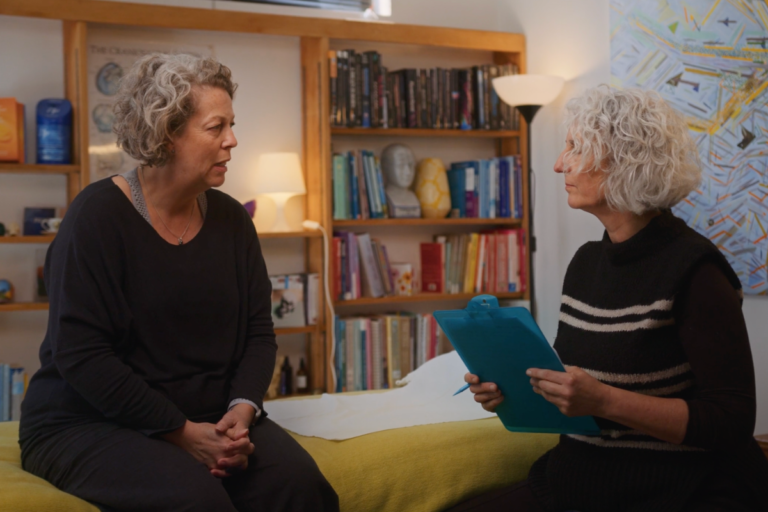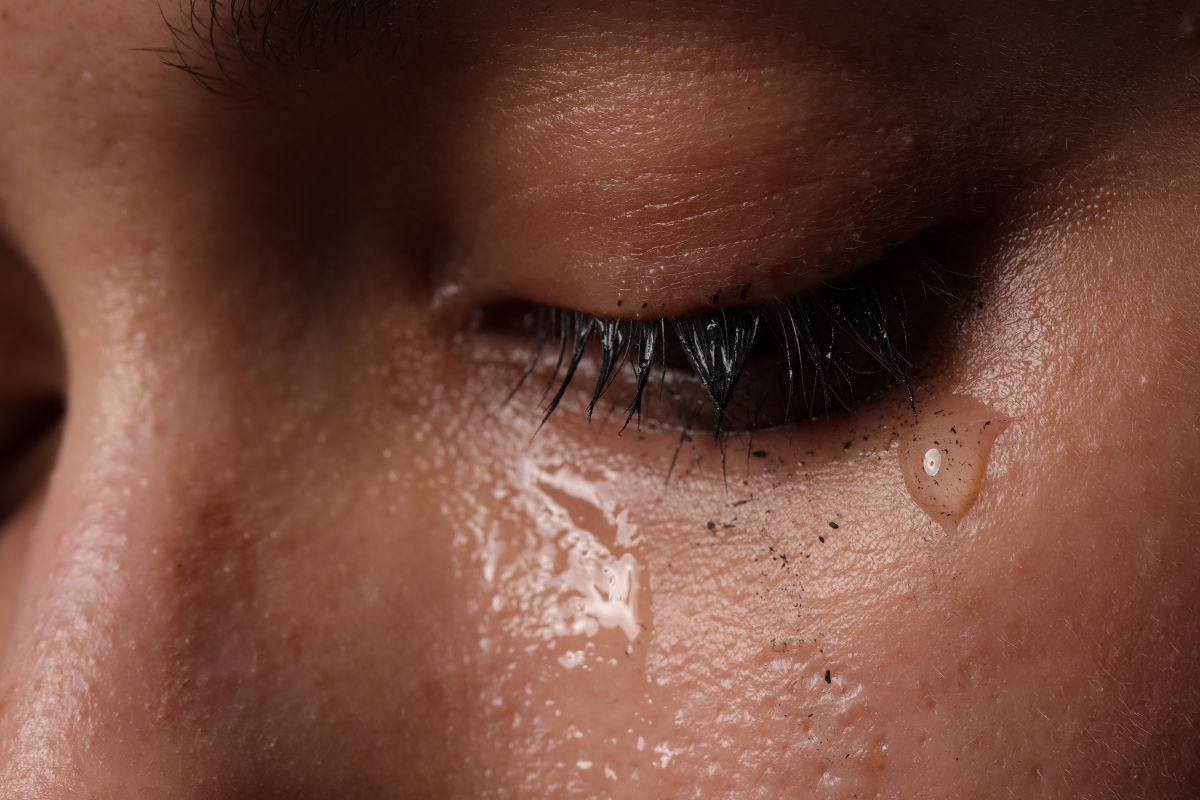
Sometimes something happens to people when they’re on a therapy table that they weren’t expecting, and they can sometimes feel embarrassed about it afterwards.
They cry, or feel very close to crying during a treatment.
Or feel a wave of something come up that they can’t quite name but that has tears somewhere in it.
And then they apologise.
I want to explain why that’s almost never necessary.
Not because it’s fine in a vague, reassuring sort of way (although it is!), but because there’s a specific physiology to what happens in those moments. Once you understand that, tears becomes perhaps less surprising, and possibly more welcome.
By Caroline Barrow CST-D MCSS
First, a strange fact
Humans are the only animal on earth that cry emotionally. Biologically no other species has been shown, in controlled conditions, to produce tears in response to an emotional state. Which raises an interesting question about what emotional tears are actually for, and why only we do it.
The answer, as best as current science can work out, seems to be several things at once.
What’s actually happening when you cry
The physiology in tears
When emotional tears come, as opposed to the kind that happen when you chop an onion or get something in your eye, they are chemically different. They contain higher concentrations of stress hormones, including adrenocorticotropic hormone (one of the body’s main stress responders) and something called leucine enkephalin, which is an endogenous opioid – a natural painkiller produced by the body itself. One hypothesis is that the body is using the tear duct as a form of excretion; letting go, quite literally, of the biochemical load that has been building up through stress.
This is still debated in the research, as replications of the original studies that showed this have had mixed results. But the chemical difference between emotional tears and other kinds is well established, even if what it means is still being worked out.
What’s less debated is what happens to the nervous system during and after a good cry.
At the start, the sympathetic system tends to fire – heart rate goes up a little, breathing changes, the body has a physical bracing type reaction. But as crying continues something shifts; there’s a change in body state sometimes with a sort of resolution. This is when the parasympathetic nervous system comes in – the branch responsible for rest, settling, digestion, repair. Heart rate slows, breathing changes, the system has a chance to come down from wherever it was. It’s a kind of reset – the body moves through something and out the other side.
Sobbing itself, and the rhythmic breathing that often comes with it, may have its own settling effect. There’s research suggesting that rhythm has something in common with other repetitive, self-soothing behaviours that are known to calm the nervous system. Which makes a certain intuitive sense if you’ve ever watched someone cry and naturally started rocking or breathing with them.
Why it happens in sessions
Because the body feels safe.
I’ve seen this enough times now, as have many colleagues, that it doesn’t surprise me at all when it happens – though the client is sometimes very surprised. Especially if they’ve come with a physical complaint. They’re not usually expecting that when we’re working with something that seems quite structural, all of a sudden there would be tears.
What seems to happen is that the body, when it feels genuinely safe and attended to, begins to let go of things it has been holding. Sometimes for years. Sometimes its obvious why, sometimes not so much. There’s not always a clear story or a reason the person can name, just something softening, something moving, and tears. Sometimes the memory comes later.
The research on this is actually quite interesting. Crying is most likely to produce real mood improvement and genuine relief when certain conditions are in place – the main one being that the person crying feels safe, and supported. When someone cries in front of strangers or in a context of shame or embarrassment, the effects are quite different. But when someone is crying during a treatment, with another person who is calm, attentive, and non-reactive – which is, or should be, exactly what a good session offers – the nervous system responds to that. The body can intuitively sense the environment, which will make a difference to the release that becomes possible.
This is part of what our approach calls SomatoEmotional Release – the principle for which is that the physical and emotional layers of experience are not nearly as separate as we sometimes treat them.
If you’ve been holding it back…
Why not try letting it out!
Some people feel the inkling to cry and resist it – out of habit, or politeness, or a sense that it’s somehow not appropriate, even on a therapy table. I do understand that. We live in a culture that tends to associate crying with losing control, or with being a burden, or sometimes people feel it will just make things worse and not actually be helpful in any way. Others are concerned that if they start they might never actually stop or be able to cope with the emotion as it flows through.
But the research suggests that suppressing emotional responses – holding the body in a state of not-releasing, over time – has its own costs. There are associations with chronic tension, with elevated blood pressure, with the kind of thing that just doesn’t shift however much surface-level work gets done on it. The body has a release mechanism, and it works better when it gets to use it.
Which is not to say you should force anything. You can’t manufacture a useful cry, and pushing through reluctance isn’t the point. But if you’re lying there and something wants to come, and you’re holding it back because you’re worried about what your CST therapist will think, or whether it’s appropriate, or whether you’ll make a mess of yourself – please don’t. Crying during a treatment can be a really good thing. This is probably one of the more appropriate places for it that you’ll find.
We won’t be surprised. It won’t be as awkward as you might think. We’ll just stay present with it.
And very often, something in the body shifts afterwards that hadn’t been able to shift before.
Want to find out more about the science? Check out this article:
Bylsma, Gračanin & Vingerhoets (2019). The neurobiology of human crying. Clinical Autonomic Research, 29(1), 63-73.
Caroline Barrow CST-D MCSS BSc is Director of Upledger Institute UK and Founder of the College of Body Science. She has been practising and teaching anatomy and physiology, and then CranioSacral Therapy, for over 30 years. She has also done A LOT of crying during a treatment, on the treatment table and off of it, and is fully convinced of its physiological value!
If you would like to find someone to work with, you can find a CranioSacral Therapist near you here, or read more about what CranioSacral Therapy actually is if you are new to it.
And if you are a therapist yourself, and reading this has made you want to add CST to what you do then find out more about our training here.