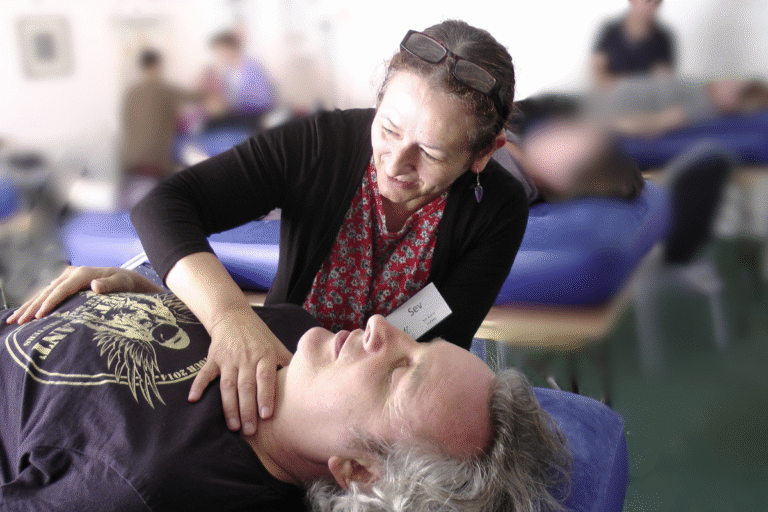
As Upledger therapists, we’re lucky to have such a powerful toolkit of techniques at our disposal. And while we need them all at different times to integrate into our treatments, most of us have a few favourites that we’re particularly fond of.
Just for fun, we asked 10 of our students, therapists, and study group leaders which techniques was the icing on the cake for them: ‘What’s the ONE technique you simply couldn’t do without in your practice?’
Here’s what they said…
Carolyn O’Neill, Cornwall
There are so many techniques to choose from but I think being “grounded, blended, neutral” (if you can call that a ‘technique’) is my absolute essential. Without neutrality none of our techniques have the same validity. Without being grounded and blended, communication with the Inner Wisdom/Physician, both our own and that of our clients, is far harder to establish and without the Inner Wisdom we are disempowering our clients process. I am also particularly fond of the vomer techniques!!!
Jan Yoxall, Kent
The main two techniques I wouldn’t be without are The Significance Detector and the Dural Tube work. The SD is so valuable – I don’t have to ask myself if I’m in the right place, the body lets me know when I’m there. Secondly, the Dural Tube work as in rock/glide seems to have a deeply therapeutic effect on everyone. I sometimes finish a session just holding the occiput and sacrum – it is a very calming, nurturing technique. Ooh, and now I want to add the respiratory diaphragm to my list…….the amount of times I hear people say “thank you I can breathe so much better now”. I guess my list is endless……..
Maggie Gill, Brighton
My absolute favourites are Arcing and the Significance Detector, as they go together. Arching shows you the body’s story. The Significance Detector shows up to let you know you’re connecting with the tissue in the right place. This is so helpful when you’re still developing confidence in your arcing skills!
Efterpi Rompoti, London
My favourite Upledger CST technique – as of recently – is the 1st Vault Hold evaluation technique. What I really like about it is that I can get an “eagle’s view” of the whole cranial base. I can evaluate the rhythm just by shifting my attention to the movement of the different bones, without changing my hand positioning. With my index and little fingers I can tune in to the Sphenoid and Occiput flexion-extension movement at the SBJ. Then my ring fingers and through the mastoid processes can sense the Temporals moving medially and laterally. And finally my palms can tune into the expansion of the Parietals.
Mary-Clare Scragg, Cumbria
To me the still point is both simple and yet profound. It can be used to introduce yourself to a client via your hands at the start of a session, to discover and access the stillness within the client during a session, and to finely tune and re-balance the client at the end allowing changes to be fully integrated.
Ann Whittle, Hampshire
I have only recently fully understood the enormity of the OCB (Occipital Cranial Base). As well as balancing the fluid flow between the cranium and the neck into the thoracic inlet, it’s also at the site of one of the lesser known chakras, the Alta Major which forms the back of the throat chakra (the hyoid representing the front). It’s a crucial chakra in the opening of the ‘the eighth chakra’ or the ‘Universal Heart’ centred at the manubrium just above the thymus gland. I realise now that it is very valuable for anyone to receive. If there are contra-indications for ‘full platform’ then appropriately gentle work in that area can only benefit the client.
Alison Williamson, Essex
It’s not really a technique, it’s more of a state, but I wouldn’t be without neutrality. It means that my only intention is to support the client in their own journey towards resolution. I don’t have to fix, heal or mend the client; I only support their process of self healing.
Caroline Barrow, Brighton
I love the temporal techniques and the feeling of the extent of their release, as if they’re going for miles. And particularly how via the temporal bones you can really get a sense of the membranes as reciprocal tensions membranes!
Gabor Vajnai, Sussex
What I like most about Upledger CST is openness. The way that in our training we are lead into this open minded approach, which holds together a rainbow of ideas to communicate with the client. Dialogue and particularly Neutrality in Dialogue is my favourite “technique”. It opens up the possibility of communicating with the intelligence of any parts or aspects of the body and the psyche while holding an open space for “IT” to express itself.
And you? What’s yours?